Morumbi Studio is a creative studio with an emphasis on videogame development.
Origins: Pitch Deck + USP
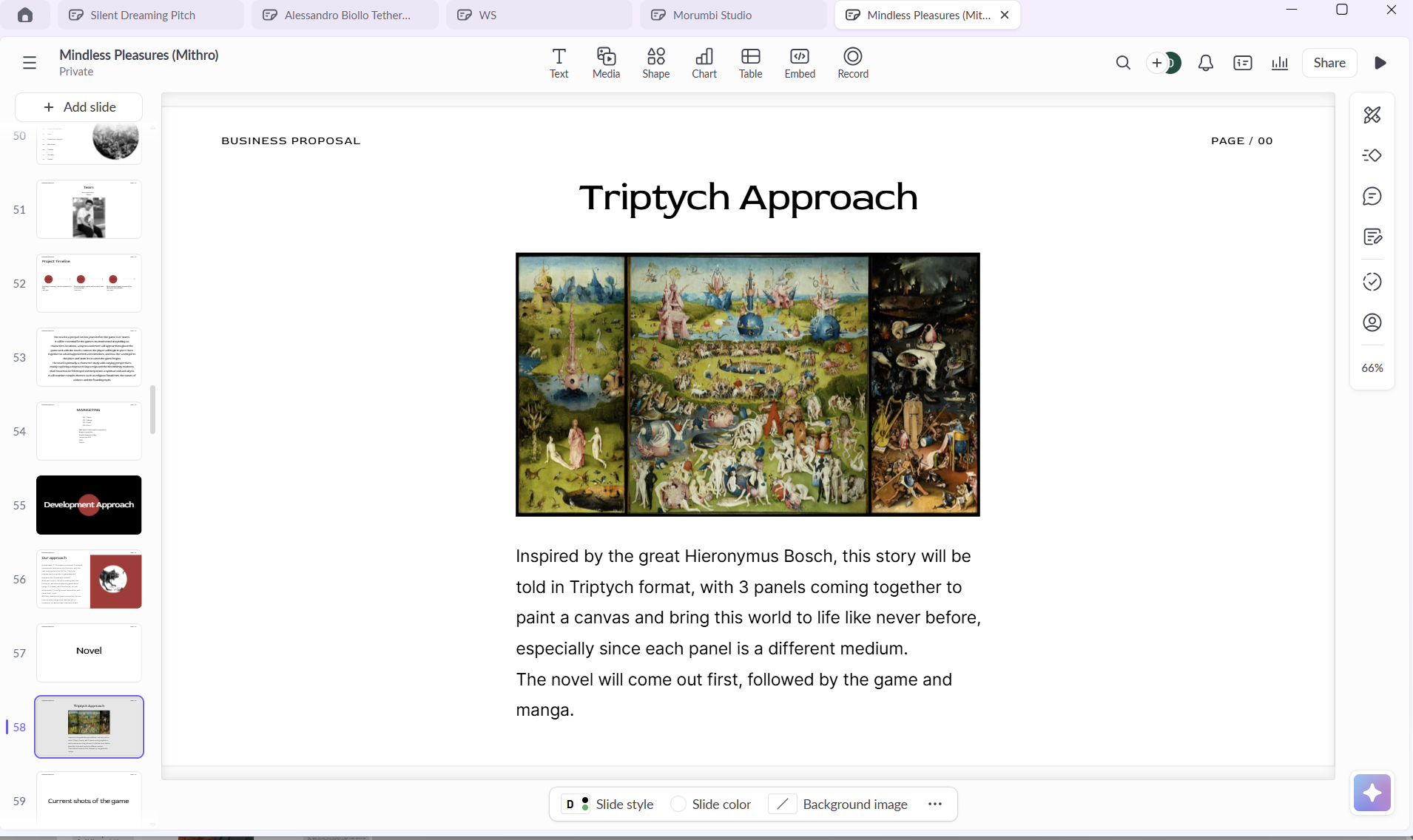
After graduating at the University of Utah, I went back to Sao Paulo, Brazil, my home city, where I met with an investor I’d been in talks with for a film or videogame project for a long time. I had a unique idea inspired by the great Dutch painter Hieronymus Bosch, on a Triptych project/art piece that would create an all encompassing vision of a dark fantasy world by using the unique qualities each medium possesses.
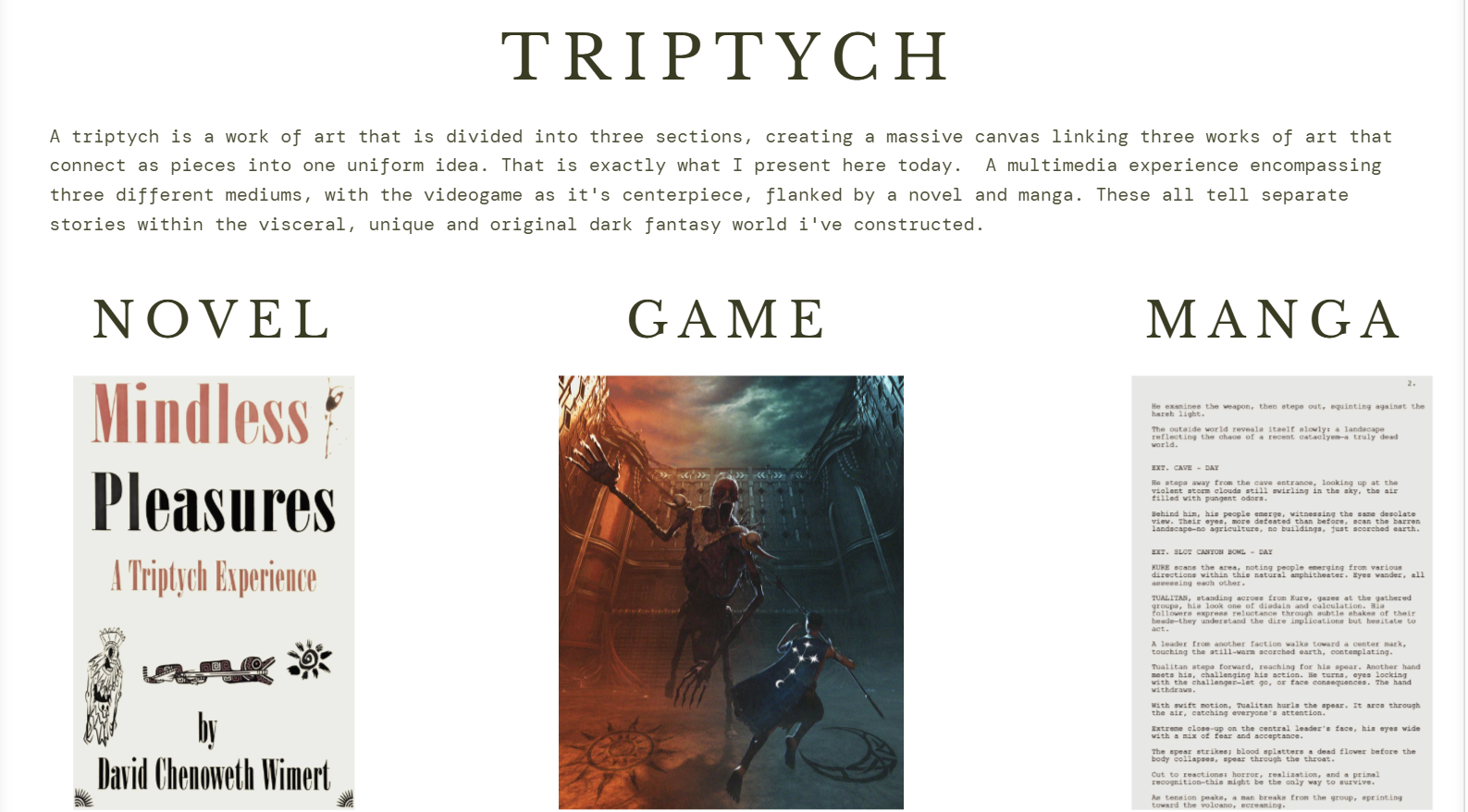
This was showcased with 3 pieces of one singular project.
A videogame prototype, pitch deck, budget, storyline, concept art and team proposal.
Manga storyboards
Novel excerpts (3 chapters).
The differentiator, here, was that the novel was a prequel, the manga was a bridge between timelines and the game was the sequel/actual timeline.
The pitch consisted of concept art, timeline, storyboards, novel chapters and an early prototype of the game. The business plan showcased games, manga and books in the genre and comparable sales titles.
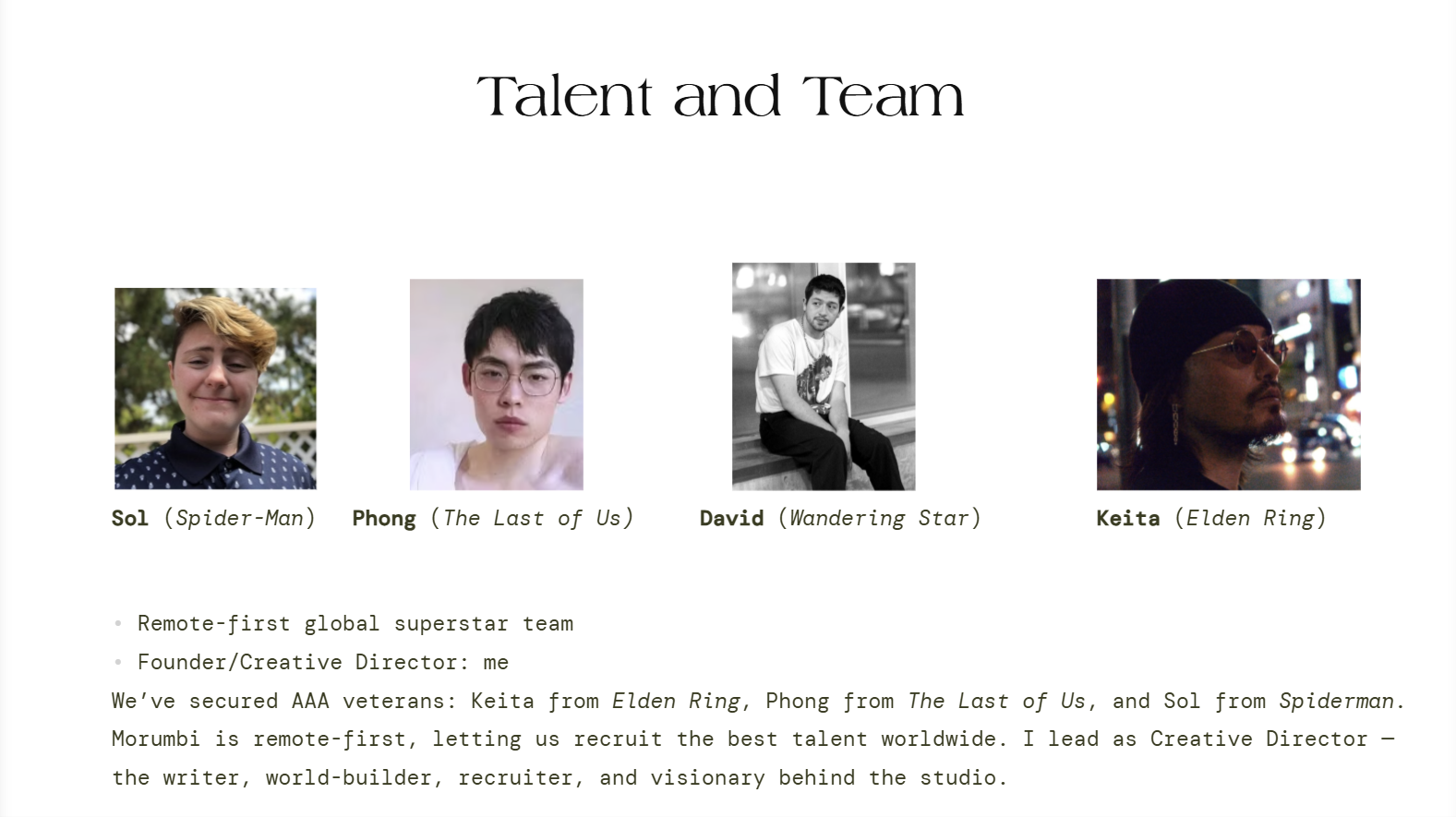
To make sure the project reached our goals, I recruited a remote first, global team of superstars in their positions. Veterans from Elden Ring, Spider Man and The Last of Us. The first thing to know is what you don’t and to find people that can help plug those gaps and bring incredible technical expertise.
STUDIO IDENTITY
(GRAPHIC DESIGN + PHILOSOPHY)
Morumbi is a special word and a special place for me. It’s a beautiful neighborhood, in Sao Paulo, where I frequented often and was raised nearby. It’s a romantic, mysterious word, originally from the Tupi indigenous language that translates etymologically to “river of the big fish”.
I wanted to create something symbolic and personal that connected to the studio’s philosophy and approach to development and art. Something with striking colors and shapes. Memorable. I’ve always been in love with nature and to me there is nothing quite as mystical and timeless as the ocean. And out of all the ocean’s creatures, to me the definition of an elegant and alien swimmer is the Manta!
In explorations for the studio’s graphics, an image of a “river with stars” kept reoccurring in my mind and connected, albeit in a fantastical way, to the original meaning of the word.
We then proceeded to develop animation of the studio’s title, of the manta swimming in a river of stars, unveiling the logo. Banners for Facebook, LinkedIn, Youtube were made in multiple formats, including textured, inversed and multiple aspect ratios to fit whatever was needed.
FIRST GAME process
(ideation, concept and journey)
Phase 1: Pitching (May 2024)
the first thing was to showcase the concept in an intriguing and engaging way. From my relationship and past with him, I understood the investor’s profile as old school, so I put together a beautiful physical art book that clearly communicated the aesthetic, the differentiators, the world and it’s brutality.
clear understanding of investor goals, objectives. Transparency in communication to understand timeline, what success meant for us, whilst explaining clear risk inherently associated with game development.
pitched a conservative budget to mitigate risks with deliverable based structure. Payments would be sent only when absolutely necessary, to build trust in how economic, cautious and serious I’d take his capital.
Following this, the LLC was formed. Got in touch with a lawyer to procure necessary documentation for freelance/contractor contributors, including artistic deliverable based agreement and NDA’s.
Phase 3: Recruitment, Scouting (Moneyball), Paperwork, Structure and Activation
(Aug-December)
In the beginning, there was only one team member I was sure I was going to work with, and that was Israel Botelho, a Brazilian monster designer/artist. I had talked to him since University about a potential project.
This meant that the team building process included countless interviews, where I learned a lot on setting expectations, clear deliverables, project structure in a clear away.
I also learned, very quickly, that due to the nature of the world class talent I sought to work with in this project, that I was often pitching them in recruitment, and that this really benefitted me in learning more of the art of pitching. Specifically, I started seeing that the world and narrative I constructed came off as complex in the worst possible ways and that the pitch was actually quite convoluted. This became a process I felt very proud of, as every subsequent interview I nailed down the essence of the project more and more.
Simplicity is the ultimate sophistication!
Phase 4: Development
(Dec-July 2025)
Development faced it’s challenges (as it always does and will) but ultimately was rather straightforward. Our goals were clear, aligned and we were efficient as a group on time, communication was always direct and we delivered an incredibly high vertical slice for the budget and team size.
I think the biggest thing I took away was that to truly make it enjoyable as a process for myself, personally, you do have to get comfortable with the uncomfortable. There were assets that broke, code that malfunctioned and times where it seemed like shipping the finalized version was impossible. The stress of entrepreneurship can have us making mistakes left and right where the right move is often to slow down and realize that everything can be resolved with correct planning and the right team, which we absolutely had.
Phase 2: Planning (June - Aug 2024)
Now, onto phase 2! What was important to me was that the budget wasn’t flexible in allowing me to make a mistake. This meant I had to paper prototype and stress-test the project, the aesthetic and more as much as possible.
I also understood, rather quickly, how inexperienced and fortunate I was to be in the position I was. I knew, in quick research and resource searching, that I was facing stern competition not only in an industry way (videogames are hard) but with how many levels there are to getting a startup where you envision it. This meant that I needed to find someone more knowledgeable then me as soon as humanly possible in a mentorship capacity. This is when I thought of Greg!
Greg Bayles, former professor of mine, was one of my biggest inspirations at University due to how knowledgeable he was/is in a generalist sense. He is quite talented at the multiple disciplines necessary to put a game together. We started doing sessions reviewing the GDD, Unique Selling Points, art and more.
The next step was timeline. I can say that, in retrospect, I’m very proud that a document I outlined in August ended up lining up perfectly to the timeline all the way to May. It was precise to almost the date, hitting milestones and learning that certain things, like the conceptual phase, can be 2-3 weeks longer then expected whilst VFX or SFX, when workflows are integrated and understood, can accelerate while maintaining the quality. This is a valuable skill for the future, in understanding what can be pushed, accelerated and when to pause. It also taught me the true definition of what we call, in futebol (soccer), “man management”. See this in the learnings below.
Another thing that I think is absolute in relevance from the planning stage was the importance of self belief, vision and understanding your “medium”. This can be encapsulated quickly into taking your time to really get yourself in the best possible balance of mental and physical shape for the grueling road ahead, and pairing that together with believing you can do it because the statistics and conventional wisdom points towards failure and struggle, so you have to find that self belief and in some ways, delusion that you can do it. The vision has to be crystal clear and easily defined/explained so that someone outside of your industry understands your product/game or whatever you’re building. Less then 30 seconds is generous, in my personal experience, in how quickly someone can lose interest. So be ready with a razor sharp pitch. (and swords sharpen swords, so being in touch with people in your community and that are on a similar path isn’t necessarily competition but inspiration).
In regards to how much planning is realistic, I’d say it’s somewhat of a balance versus experimentation and playtesting/validation of the concept, game development is a unique artform in the sense that it’s more of a sculpture and fluid process then a precise, stiff painting. It’s constantly changing. There are mechanics you paper prototype or envision as working and it clearly translates, but there also challenges that emerge from the original vision that can be entirely scrapped, remixed or other, and the only constant in the process is change.
Phase 5: WS Endgame (for now!)
(August-Dec 2025)
Finally, it was time for pitching to publishers/VC’s to get our major funding. We were presenting a demo, about 3.5 mins in length. This consisted of the game’s combat, visual and animation fidelity as well as it’s world design.
After careful research of publishers that aligned with us in scope and genre, I started the applicant process.
Had several video calls and long email exchanges, where I heard all the positives as well as the very real critiques and feedbacks that showcased a lot of challenges the project “Wandering Star” faced if we were to be funded.
The long story short was: Our genre is ultra competitive, with the big players in the market having projects up to 50-70 million dollars in funding. We were looking to compete with that with a budget of 1.5-3m, which was high considering our team was unproven as a unit and I was unproven in having never shipped a game, period. Additionally, though the art, narrative and world were quite stunning, the gameplay itself didn’t offer enough USP to warrant an investment. (This was quite the eye opener and changed my perception).
Time to go again!
Phase 6: “Tethered” and future projects.
(Jan-Present)
I’ve always loved the horror genre, and we are currently taking all of our learnings as a studio into a follow up project that addresses all of our problems in the previous project.
The game is slated for a January, 2027 demo.